When
the persecution of the people of Makkah against the Muslims
grew intense, Allah commanded them to emigrate so that they
could establish the religion of Allah in a land where they
could worship Him.
Allah
chose Madinah as the land of Hijrah (emigration for the sake
of Allah). The Messenger (peace and blessings be upon him)
saw in a dream that he was immigrating to that city. It was
narrated from Abu Musa that the Prophet (peace and blessings
be upon him) said: “I saw in a dream that I was emigrating
from Makkah to a land in which there are date palms, and I
thought that it was Al-Yamamah or Hajar, but it turned out
to be Madinah, Yathrib.” (Al-Bukhari and Muslim)
Al-Bukhari
also narrated on the authority of `A'ishah that the Prophet
(peace and blessings be upon him) said to the Muslims: “I
have been shown the land to which you will immigrate: it has
palm trees between two lava fields, two stony tracts.”
So, some people immigrated to Madinah, and most of those
people who had previously immigrated to the land of
Ethiopia, returned to Madinah.
Commenting
on this hadith, Al-Hafiz wrote: "The harrah (stony
tract) is land whose stones are black. This dream was
different from the dream mentioned above in the hadith of
Abu Musa in which the Prophet (peace and blessings be upon
him) was not sure where that land was. Ibn At-Teen said: The
Prophet (peace and blessings be upon him) was shown the land
of immigration in a way that could apply to Madinah and to
other places; then he was shown the feature that is unique
to Madinah so it became clear which land that was.”
With
regard to the first Companions of the Prophet (peace and
blessings be upon him) to emigrate, Al-Bara' (may Allah be
pleased with him) said: "The first ones who came to us
of the Companions of the Prophet (peace and blessings be
upon him) were Mus`ab ibn `Umayr and Ibn Umm Maktum. They
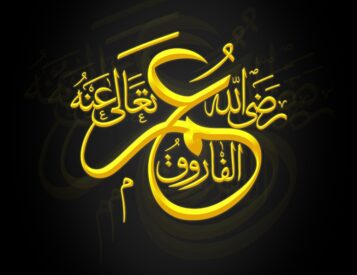
started to teach us the Qur’an. Then `Ammar, Bilal, and
Sa`d came, then `Umar ibn Al-Khattab came with twenty
others. Then the Prophet (peace and blessings be upon him)
came, and I never saw the people of Madinah rejoice more
than that. They rejoiced so much that I saw the girls and
boys saying, ‘This is the Messenger of Allah (peace and
blessings be upon him), he has come’” (Al-Bukhari).
The
following hadith sums up many of the events of the
Prophet’s emigration: It was narrated on the authority of
`A'ishah that he Prophet (peace and blessings be upon him)
said to the Muslims: “In a dream I have been shown your
place of immigration, a land of date palm trees, between two
lava fields, the two stony tracts.” So, some people
immigrated to Madinah, and most of those people who had
previously immigrated to the land of Ethiopia returned to
Madinah. Abu Bakr also prepared to leave for Madinah, but
the Messenger of Allah (peace and blessings be upon him)
said to him, “Wait for a while, because I hope that I
will be allowed to emigrate also.” Abu Bakr said,
“Do you indeed expect this? May my father be sacrificed
for you!” The Prophet said, "Yes." So Abu
Bakr stayed behind for the sake of the Messenger of Allah
(peace and blessingsbe be upon him) so that he could
accompany him. He fed two she-camels he owned for four
months.
One
day, while we [`A’ishah is still narrating] were sitting
in Abu Bakr's house at noon, someone said to Abu Bakr,
"This is the Prophet (peace and blessings be upon him)
with his head covered, coming at a time at which he never
used to visit us before." Abu Bakr said, "May my
father and mother be sacrificed for him. By Allah, he has
not come at this hour except for something important."
So the Prophet (peace and blessings be upon him) came and
asked permission to enter, and he was admitted. When he
entered, he said to Abu Bakr: "Tell everyone who is
present with you to go away." Abu Bakr replied,
"There is no one here but you are my family.
May
my father be sacrificed for you, O Messenger of Allah!"
The Prophet said, "I have been given permission to
emigrate." Abu Bakr said, "Shall I accompany
you?" The Messenger of Allah (peace and blessings be
upon him) said, "Yes." Abu Bakr said,
"O Messenger of Allah, may my father be sacrificed for
you, take one of these two she-camels of mine." The
Messenger of Allah (peace and blessings be upon him)
replied, "(I will accept it) with payment."
So we prepared the baggage quickly and put some journey food
in a leather bag for them. Asma’, the daughter of Abu
Bakr, cut a piece from her waist belt and tied the mouth of
the leather bag with it, and for that reason she was named dhat
al-nitaqayn, the One with Two Waistbelts.
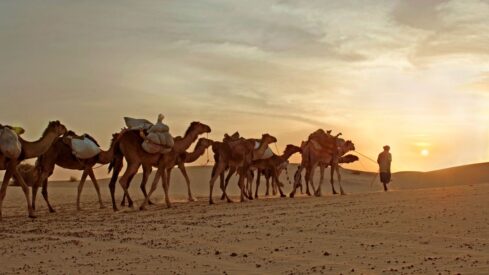
Then
the Messenger of Allah (peace and blessings be upon him) and
Abu Bakr reached a cave on the mountain of Thawr and stayed
there for three nights. `Abdullah ibn Abi Bakr, who was an
intelligent and wise youth, stayed (with them) overnight. He
would leave them before daybreak so that in the morning he
would be with the Quraysh, as if he had spent the night in
Makkah. He would keep in mind any plot made against them,
and when it became dark he would (go and) inform them of it.
`Amir ibn Fuhayrah, the freed slave of Abu Bakr, used to
bring the milch sheep (of his master, Abu Bakr) to them a
little while after nightfall. So they always had fresh milk
at night, the milk of their sheep. `Amir ibn Fuhayrah would
then take the flock away when it was still dark (before
daybreak). He did the same on each of those three nights.
The Messenger of Allah (peace and blessings be upon him) and
Abu Bakr had hired a man from the tribe of Banu Ad-Dayl from
the family of Banu `Abd ibn `Adiy as an expert guide, … he
was of the religion of the polytheists of the Quraysh, but
the Prophet and Abu Bakr trusted him and gave him their two
she-camels and made an appointment with him to bring their
two she-camels to the cave of the mountain of Thawr in the
morning after three nights had passed. And (when they set
out),`Amir ibn Fuhayrah and the guide went along with them
and the guide led them along the coast.
Ibn
Shihab said: `Abdur-Rahman ibn Malik Al-Mudliji, who was the
nephew of Suraqah ibn Malik, told me that his father
informed him that he heard Suraqah saying: The messengers of
the Quraysh came to us declaring that they had assigned for
the persons who would kill or arrest the Messenger of Allah
(peace and blessings be upon him) and Abu Bakr, a reward
equal to their blood-money. While I was sitting in one of
the gatherings of my tribe, a man from them came to us and
stood while we were sitting, and said, “O Suraqah! I have
just seen some people far away on the shore, and I think
they are Muhammad and his companion.” Suraqah added: I
realized that it must have been them. But I said, “No, it
is not them, but you must have seen so-and-so, and so-and-so
whom we saw setting out.” I stayed in the gathering for a
while and then got up and left for my home. I ordered my
slave-girl to get my horse, which was behind a hillock, and
keep it ready for me.
Then
I took my spear and left by the back door of my house
dragging the lower end of the spear on the ground and
keeping it low. Then I reached my horse, mounted it and made
it gallop. When I approached them (i.e., Muhammad and Abu
Bakr), my horse stumbled and I fell down from it. Then I
stood up, got hold of my quiver and took out the divining
arrows and drew lots as to whether I should harm them or
not, and the lot which I disliked came out. But I remounted
my horse and let it gallop, giving no importance to the
divining arrows. When I heard the recitation of the Qur’an
by the Messenger of Allah (peace and blessings be upon him)
who was not looking around although Abu Bakr kept doing
that, suddenly the forelegs of my horse sank into the ground
up to the knees, and I fell down from it. Then I rebuked it
and it got up but it could hardly lift its forelegs from the
ground, and when it stood up straight again, its forelegs
caused dust to rise up in the sky like smoke. Then again I
drew lots with the divining arrows, and the lot which I
disliked came out. So I called to them to let them know they
were safe. They stopped, and I remounted my horse and went
to them. When I saw how I had been hampered from harming
them, it came to my mind that the cause of the Messenger of
Allah (peace and blessings be upon him) would become
victorious. So I said to him, "Your people have
assigned a reward equal to the blood-money for your
capture." Then I told them all the plans the people of
Makkah had made concerning them. Then I offered them some
journey food and goods but they refused to take anything and
did not ask for anything, but the Prophet (peace and
blessings be upon him) said, "Do not tell others
about us." Then I requested him to write for me a
guarantee of security. He ordered `Amir bin Fuhayrah to
write it for me on a piece of animal skin, then the
Messenger of Allah (peace and blessings be upon him) went on
his way.
When
the Muslims of Madinah heard that the Messenger of Allah
(peace and blessings be upon him) had departed Makkah and
was heading towards them, they started going to the harrah
(stony tract formed of lava) every morning. They would wait
for him till the heat of the noon forced them to return. One
day, after waiting for a long while, they returned home, and
when they went into their houses, a Jew climbed up onto the
roof of one of the forts of his people to look for
something, and he saw the Messenger of Allah (peace and
blessings be upon him) and his companions dressed in white
clothes, as if they were emerging out of a desert mirage.
The
Jew could not help shouting at the top of his voice, "O
Arabs! Here is your great man whom you have been waiting
for!" So all the Muslims rushed to pick up their
weapons and went to meet the Messenger of Allah (peace and
blessings be upon him) on the lava field. The Prophet turned
to the right and alighted in the land of Banu `Amr ibn `Awf.
This was on a Monday in the month of Rabi` Al-Awwal. Abu
Bakr stood receiving the people while the Messenger of Allah
(peace and blessings be upon him) sat and kept silent. Some
of the Ansar (Helpers), who came and had not seen the
Messenger of Allah (peace and blessings be upon him) before,
began greeting Abu Bakr, but when the sunshine fell on the
Messenger of Allah (peace and blessings be upon him) and Abu
Bakr came forward and shaded him with his cloak, only then
did the people recognize the Messenger of Allah (peace and
blessings be upon him).
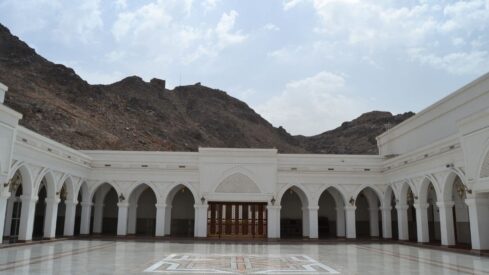
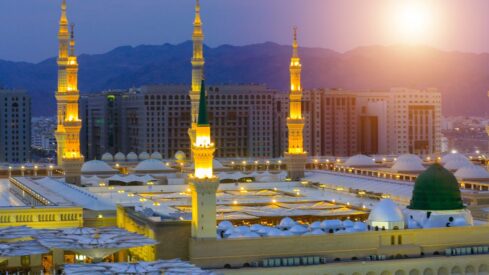
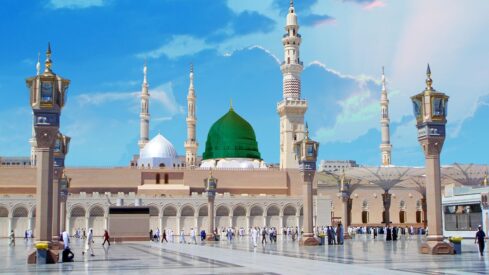
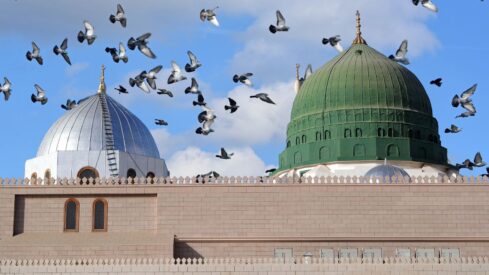
The
Messenger of Allah (peace and blessings be upon him) stayed
with Banu `Amr ibn `Awf for ten nights and established the
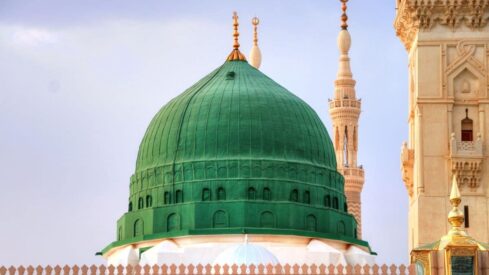
mosque that was founded on piety, the Mosque of Quba'. The
Messenger of Allah (peace and blessings be upon him) prayed
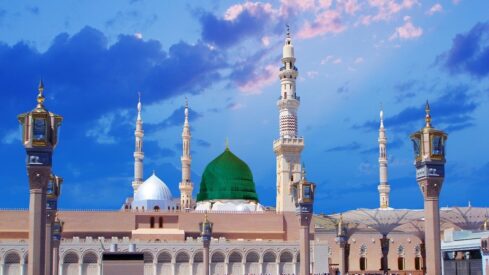
in it and then mounted his she-camel and moved on,
accompanied by the people till his she-camel knelt down at
the place where the Mosque of the Prophet now stands in
Madinah. Some Muslims used to pray there in those days, and
that place was a yard for drying dates belonging to Suhail
and Sahl, two orphan boys who were under the guardianship of
As`ad ibn Zurarah. When his she-camel knelt down, the
Messenger of Allah (peace and blessings be upon him) said, "This
place, Allah willing, will be our place." The
Messenger of Allah (peace and blessings be upon him) then
called the two boys and told them to name a price for that
yard so that he might take it as a mosque. The two boys
said, "No, but we will give it as a gift, O Messenger
of Allah!" The Messenger of Allah (peace and blessings
be upon him) refused to take it as a gift and insisted on
buying it from them.
The
Prophet (peace and blessings be upon him) built a mosque
there. He himself helped in the construction. He started
carrying unburned bricks for its building and while doing
so, he would say, "This load is better than the load
of Khaybar, for it is more pious in the sight of Allah and
purer and better rewardable." He was also saying, "O
Allah! The actual reward is the reward in the Hereafter, so
bestow Your Mercy on the Ansar and the Muhajirun
(Immigrants)."