|
To those whose record of deeds has become blackened after Ramadan, here
is an opportunity to cleanse it again. It is an opportunity for purification
and forgiveness, and to get rid of sins and their heavy burdens. From time
to time Allah the Almighty bestows the blessings of His forgiveness and
contentment. Shortly after Ramadan come the days of goodness and blessings
in which doing good is much more rewardable than doing good even during the
month of Ramadan itself.
As soon as the day time passes away, the night time comes with the
blissful offer of receiving forgiveness from Almighty Allah; as He the
Almighty kindly says to His servants [in the last third of night time], “Is
there a seeker of forgiveness so that I forgive him? Is there a repentant to
me so that I pardon him?” (Authenticated by Al-Albani)
Moreover, whoever indulges in worldly affairs at night and misses asking
for forgiveness during the pre-dawn hours, Allah the Almighty grants him
another opportunity to seek His pardon during the daytime. There are many
seasons of mercy, forgiveness and contentment from Allah the Almighty
throughout one’s life; and the loser is the one who wastes all this and
meets Allah while He the Almighty is angry with him.
Of these seasons are the first ten days of Dhul-Hijjah.
In this regard the Prophet (peace and blessings be upon him) was reported
to have said, "There are no days in which good deeds are more
beloved to Allah than in these days, meaning the ten days of Dhul-Hijjah.
They
– some of the Companions of the Prophet (peace and blessings be upon him)
said, “O Messenger of Allah: not even struggling for the sake of Allah? He
said: Not even struggling for the sake of Allah except a man who left
with his soul and money and returned with neither." (Authenticated
by Al-Albani)
Once the Prophet’s Companion, Sa`id ibn Jubair (may Allah be pleased
with him) heard this hadith and said that he would exert so much effort when
these days come that he would be too exhausted to do more. Moreover, he was
quoted as saying: “Do not turn off your lights during the nights of these
ten days" as he loved offering acts of worship during this time.
This is an invitation to compensate for the missed opportunities during
one’s past lifetime; offering one rak`ah during these days is the
same as offering many; saying one statement of remembering Almighty Allah is
as rewardable as saying many; and one act of giving charity receives the
reward of giving a great deal; and so on.
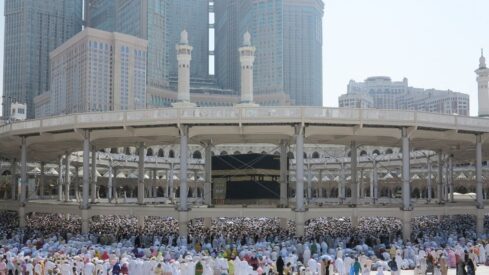
Muslims in Allah’s Sacred Mosque keep praying to Almighty Allah until
they become extremely tired and intend to rest, but when they start to do
so, they remember that a rak`ah in Allah’s Sacred House is rewarded
with a hundred thousand rak`ah reward, so they forsake rest and stand
devoting their time to Almighty Allah in prayer. When they feel exhausted
again, they console themselves with remembering the Hereafter and that
encourages them to endure the effort, so that they do not miss the great
rewards Almighty Allah offers in this sacred place.
Keep in mind that doing good deeds in the first ten days of Dhul-Hijjah
are superior to doing the same in other days even if that is offering
worship in Allah’s House itself during other days! Imagine, the reward of
one rak`ah in Allah’s House originally is equal to the reward of a
hundred thousand rak`ah therein; so what will be the reward of a rak`ah
during these days [in Allah’s House or elsewhere]! Surely, a good deed in
these days is equal to a reward of hundreds or even thousands of good deeds.
Hence, doing one’s best in offering good deeds during these days is an
opportunity to set right one’s past.
“’A woman went to the Prophet (peace and blessings be upon him) and
said: ‘Oh Allah’s Messenger, my husband set out for jihad in Allah’s
cause, and I used to follow in his footstep in prayer and everything. So,
tell me about a good deed that equals his now [fighting in Allah’s cause]
that I can do until he comes back.’ He (peace and blessings be upon him)
answered her, ‘Could you stand in prayer without ever sitting, offer
fasting without ever breaking it, and saying dhikr (remembering
Allah) without ever getting bored until he comes back?’ She said: ‘I
cannot endure doing all this!’ He (peace and blessings be upon him)
commented saying: ‘By Him in Whose Hand is my soul, even if you were to
endure this, you would not have been able to reach a tenth of his reward!’
(Reported by Ahmad)
Abu Hurairah (may Allah be pleased with him) was also quoted as saying
“The Prophet (peace and blessings be upon him) was asked: ‘What is it
which equals Jihad in Allah’s cause, Allah’s Messenger?’ He (peace and
blessings be upon him) said, "You do not have the strength to do
that deed!" However, the Companions repeated the question two or
three times, and each time he (peace and blessings be upon him) gave the
same answer, and then said, "One who goes out for Jibad
is like a person who keeps fasting, stands in prayer (constantly), obeying
Allah's (orders contained in) verses (of the Qur'an), and does not exhibit
any lassitude in fasting and prayer until the Mujahid returns from Jihad in
the way of Allah the Exalted." (Al Bukhari
and Muslim, the wording is Muslim’s).
Therefore, the person who wants to receive the merit of jihad and wins
this blissful race of doing good has to offer constant prayer and fasting;
if the person gets some rest, he would lose the race. Who can do this?
Now, imagine that you can do this; you can win the race of good deeds;
like offering acts of worship such as prayer, fasting, remembrance of Allah,
seeking His forgiveness, supporting the needy, and relieving the burdens of
the people in distress. During the first ten days of Dhul-Hijjah such deeds
are heavier in the scale of good deeds than jihad in Allah’s cause itself.
Therefore, whosoever has been lazy to offer good deeds, shown negligence
in matters of worship, intended to do good but did not take any action
toward it, and indulged himself in this worldly life, forgetting about the
Hereafter, let him or her seize this opportunity to make up for the past
sins and seek a fresh start.
|